There are times when I have found myself in a conversation with someone and I begin to feel like the proverbial lunatic. The person so detached from a reality in which everyone else has agreed to participate. At some point, I took the red pill. Or maybe I took the blue one. Who knows. In these conversations, the bottom line for the other person (or people) is always about humanity.
I remember the day I found my One Health degree and read the description. It was everything I had always believed in my entire life and there was an ACTUAL degree for it. I was so excited and thought I would graduate fully prepared to take on a project bringing together a wealth of disciplines to understand how to best serve some system or another (depending on my employer). That did not happen. To be clear, my program did prepare me for this. The problem is, here in the United States, what the f*uck is One Health? While biology, capitalism, and my “western” surroundings prefer the siloed, hierarchy of things, I believe more in a flowy, intertwined, inter-being structure. No hierarchy, no apex, no isolation. Unfortunately, wherever you do find One Health programs in the U.S., they aren’t really One Health. When the USDA, NIH, and other entities create a department that is One Health or One Health-adjacent, what they are really doing is two things:
1. They are expecting the very concept of One Health to fix their problems, and fix them quickly (“if we just use a One Health approach to this antimicrobial resistance problem, then it will resolve itself and we can move on”). Then when they grow disappointed in it not being the magical cure they had hoped for, they essentially abandon the whole concept.
2. They are fixating almost entirely on the human aspect, keeping the animals and environment as components they need to adjust in someway to make life better for the human component. Once again, the animals and environments exist to serve humans. This is just “whole human health” research or an extension to our already established “infectious disease” departments. They just slapped a new label on it.
It isn’t entirely their fault. Everything in the U.S. is about making money, even in government (an entity designed to serve the people and provide for the people – yeah, our’s is entrenched in capitalism and money making). So, scientists are at the mercy of showing that their projects are worth funding because they will one day be profitable. This is what, over time, spoiled the soup for me, if you will. I no longer have a taste for being a part of that kind of science. It is, to be sure, very idealistic of me, and I am grateful to those who can stomach that side of it, because in the end, we do need people to beg for grants, conduct research, and find solutions to the myriad of problems we are simultaneously creating.
That said, I still can’t stop feeling a certain anger and frustration with the researchers who still work with animals. Not because they are working with animal models, necessarily, but because they aren’t demanding more. Why are there ethics for testing on humans, so strict that we won’t even allow it until it reaches clinical trials, but an abysmally low set of standards for testing on animals (and even fewer the further you get from primates and other mammals)? We use animals, often indiscriminately, to make pharmaceuticals, cosmetics, produce food and labor, and those we don’t use in research have their homes bulldozed and their waters and food sources polluted. We are an unkind species, as a whole, and so much of our science is meant to serve the human interest. This is a space where I think there should be a proper One Health advisor, bringing in an expert to represent the welfare of the animals. Not an industry veterinarian who thinks in siloed terms, but someone who would truly advocate for the health and livelihood of the test subjects.
The impetus of this piece
Why am I going on about this anyhow? This weekend I joined a friend to visit the open house of a research organisation affiliated with my old undergrad alma mater. The Institute of Marine and Environmental Technology (IMET) indicates on their website that they are involved in researching:
– Sustainable seafood production
– Energy, water, and the environment
– Environment, animal, and human health
That last one IS One Health, and they may very well believe they are focussing on these topics. What I learned was that they are DEFINITELY focussed on sustainable seafood. The program is actually quite industrious (choose how you want to interpret that word choice). They really are trying to create a system whereby humans might actually leave the oceans alone such that no one fish is fished to extinction or that the entire oceanic system isn’t disrupted by overfishing or human fishing practices. This, I believe, is a noble cause.
They even have a scientist who created fish food from insects in an effort to eliminate the use of traditional “fish food” which is made by more overfishing – that of fatty fish, like sardines and anchovies. They recycle their own water, in-house, and store the bio-waste as energy, generating enough to share with the local community. The researchers there genuinely seemed as though they had good intentions – and, should they succeed in their efforts, may have solved how to keep our oceans protected from caustic human behaviours. That said, let me describe the environment for you (we were not allowed to take photos, but the link provided above for IMET will give you a glimpse into what the tanks look like).
The lab (production stage, if you will) is in the basement of a large building in the inner harbor of Baltimore. This is actually a selling point for their efforts: if we can “grow” [produce] fish in the cities, we can provide a sustainable source of fish for every population. Pumps, generators, filtration systems and other equipment fill the space, along with the many large tubs of water filled with fish. It is loud, well beyond the acceptable limits for an office setting, per occupational health standards. It is a basement, so it is a canvas of grey and off-white, with a touch here and there of rust. It is very much like a laboratory, minus the benches and traditional work stations…utilitarian and devoid of joy and color. For the humans who work here, I could not care less. Having spent my fair share of time in a basement lab, I never minded it. Plus, I had agency to choose whether this was what I wanted for myself. I mention all of this on behalf of the fish.
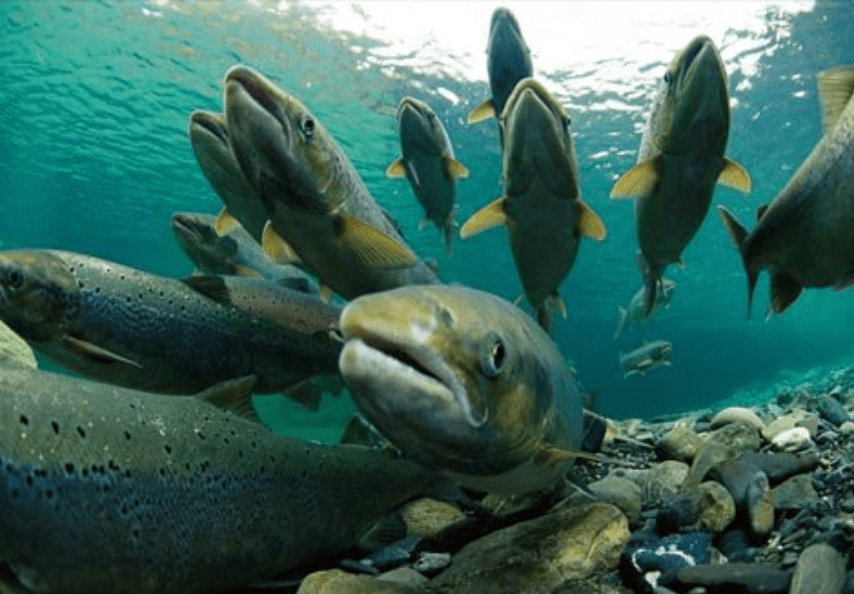
I do not know if fish have feelings or care about the environment in which they live. I’m not even sure if they release stress hormones that we could test to even check for such potential stress. Behaviorally, should we only measure their willingness to eat and swim as indicators, we would be flawed in our reasoning as even most humans in prison continue to eat and move. Whatever the case, the fish in these blue, round, man-made tanks are paying a hefty price for their oceanic brethren, living their entire lives never seeing anything apart from a handful of “caretakers” and about 40 other salmon. No kelp, no rocks, no sun or sky, no bugs, crabs, or other fish. It is a day and night of swimming around and around in a single tank with the bellowing sounds of machinery and mechanical neighbors.
Should this become a viable option, it is great to think we are saving our oceans, but we will be banishing thousands and thousands of fish each year to purgatory. It may sound as though I don’t support the project, writ large. I do…with a caveat. The animal welfare caveat. The tanks, themselves, would need to be improved, and the systems should be tested with plant matter. There needs to be an effort to consider the life of the animal, even if being grown for food.
Forget that we should push an agenda to eat more plant-based products and reduce food waste, if you can’t fix human entitlement, then it should at least be necessary to consider the life of the animal we are harvesting as food. Incidentally, a statement I heard twice from two separate researchers was “we farm pigs and cows, why not fish?”, as though this was the pinnacle of human invention. Have they looked at the conditions we keep for these terrestrial livestock? What will stop companies from engaging in deplorable practices for fish, or using the urban aquatic farming system to raise octopus or other cephalopods and sharks?

I do not doubt that each scientist there is a true believer in the cause, as defined by them. There is, unfortunately, a naivety within this community that has failed to account for what industry will do with their inventions. This might well be humans, once again, solving one problem by creating a new one. A lot of incredible discoveries, inventions, and understanding has come out of this larger project and each of the researchers involved with IMET, I do believe, are working hard to help – and who can knock a human who is working hard to help. I just don’t think they are challenging themselves hard enough to create a truly sustainable system. If they want someone to come and help them overcome their oversight, I’m happy to join their organisation!
One final note: these urban aquaculture tanks for farming salmon (and potentially other fish) are years from becoming viable features in our cities. The aquatic schema is currently ill equipped to remove a bacterial growth (geosim, I believe) that inadvertently causes the fish to taste like “mud”. Until they resolve that issue, there won’t be any city-grown salmon. The only solution at the moment is to put the salmon into a fresh tank with a continuous supply of freshwater, which defeats the entire purpose of their design that is rather incredible as far as recycling water and clearing out solid waste and urine.
If you work at IMET and are reading this, my intention is not to knock down the incredible efforts and noble intentions this institute is making. I, too, believe in these efforts. Perhaps, however, designing for animal welfare should be a mandatory part of the process if you are, after-all, hoping to one day scale this up and make it the future of food systems.
Discover more from One Health Stories
Subscribe to get the latest posts sent to your email.


I met a documentary filmmaker earlier this summer who did a movie on sustainable fishing practices being piloted in Minnesota. It’s encouraging to hear that more enterprises are trying to figure this out, but I think you’re correct that the rights of the animal aren’t being factored in at all. The water they grow in is being made cleaner to improve fish taste, not for their comfort. We have a long way to go before that’s a priority.
LikeLiked by 1 person
Oh dang, we should watch it together. I love a good documentary.
Yes, I agree. I think we will never break from our habit of prioritizing human needs over animal welfare or if we do, it’ll be a long time coming.
LikeLike