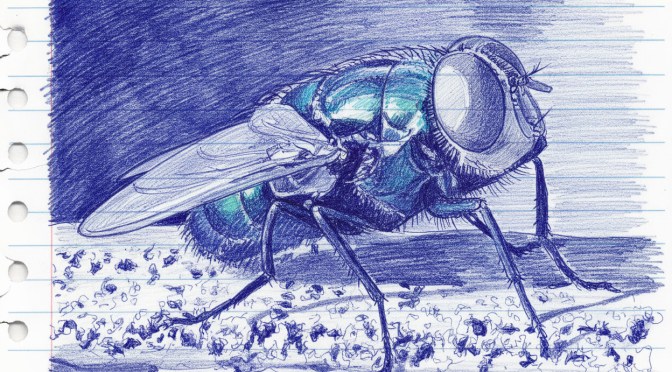
There is so much to be worried about under Trump’s Department of Health and Human Services and Department of Agriculture that it’s hard to pick which fear to unlock first. Years ago there was a show called “Monsters Inside Me” and I was obsessed. I learned that there is no greater fear than the botfly (for me) and I’ve been terrified of it since. That being said, there are far greater threats than the botfly, so I’m not saying it is a rational fear. But, unlike the botfly, the screwworm uses mammalian hosts to feed their larvae (maggots), while pupating in the soil.
The screwworm likely wasn’t on your radar if you are my age because it hasn’t been a part of our ecosystem since the 1960’s. In 1959, under Dwight D. Eisenhower, a plan to eradicate the pest from the U.S. and Mexico was hashed out, beginning with field surveys and an understanding of the fly’s life cycle and surveillance of its spread1. Teams came together and decided to use the sterile insect technique, as it had shown success elsewhere, and by 1966 it had been eradicated from the U.S. Monitoring and surveillance of the fly has continued since the 60s and that has kept our cattle and farmers safe from infection.
The sterile insect technique is a method whereby males are sterilized via radiation and released into the wild to mate with females. Enough sterile males can outcompete the wild type, resulting in no (or very little) egg fertilization. As there are no progeny (offspring) resulting from this method, there aren’t future generations of sterile males being born in the wild and, therefor, require replenishing when threats are detected. This is one of the reasons we need continuous monitoring of the fly. Apart from humans, no other species understands or follows arbitrary, political borders, so the likelihood of the fly crossing into Mexico from South America or into the U.S. from Mexico is high. This is also why one strategy our nation has employed in the past is to halt the movement of cattle and other animals between countries during an outbreak scenario, which requires international cooperation2. Additional complications include climate change and our intense cattle industry along the border, presenting a perfect scenario for a resurgence. More sterile males are required any time there is a detection event, yet when the department responsible for monitoring the spread is hollowed out, you’re left with no one to monitor or respond.
This is exactly what happened during the DOGE cuts.
So what does this affect? More than you realize. Many of the programs seen by MAGA, Musk, and others as wasteful account for such a small portion of the U.S. budget, yet have some of the greatest impact on our health and our food systems. Once cut, it takes a lot more money to rally a new team and ameliorate the burden. In other words, the loss of cattle or poultry, the quarantining process, sterilization process of the farms and abattoirs, the loss to consumers, the potential human health risk, and the man hours required to do the work of a team that should have been poised to respond BEFORE a catastrophe are all part of the cost to react to a potentially avoidable disaster.
This is yet another example of why climate change deniers, flat Earthers, anti-vaxxers, and tech bros should not be in charge of science, health, and the environment. I don’t believe in siloed fields, but I do believe in people having the credentials to make decisions on our behalf – something I have yet to see in this administration.
On the main USDA page for screwworm they mention they are taking a One Health approach. Unfortunately, anything that ends in “dot gov” leaves me feeling uncertain and with very little confidence. I rely solely on the career scientists who have kept their positions and maintained continuity throughout the past year and a half in hopes that they have enough experience to reconcile the disasters and put out the fires, large or small. In line with their One Health approach, however, they have offered up tailored advice to each stakeholder, whether they be veterinarians, ranchers, consumers, public health officials, etc. Their mapping tool (using arcgis) is one of my favorites, as you can visualize the contaminated area plus the buffer zone where spreading might occur.
So, what is a screwworm?3
It’s not really a worm, but rather it is a fly – a blow fly, to be exact, actually called the New World Screwworm Fly (NWS fly). Blow flies are a group of decomposers (the females4, specifically) that feast on carrion (animal carcasses), which is incredibly beneficial to our ecosystems. If a deer or a raccoon dies in the forest, these blow flies play a huge role in decomposing the flesh, such that within a short amount of time all that remains are the bones. They lay their eggs in the dead flesh and their progeny (the maggots) go to town, feasting. They have four life stages: egg, larva, pupa, and adult fly. So, after the maggots eat and grow a bit, they pupate (like a butterfly) in the soil and emerge as an adult fly who then lays their own eggs and the cycle continues.
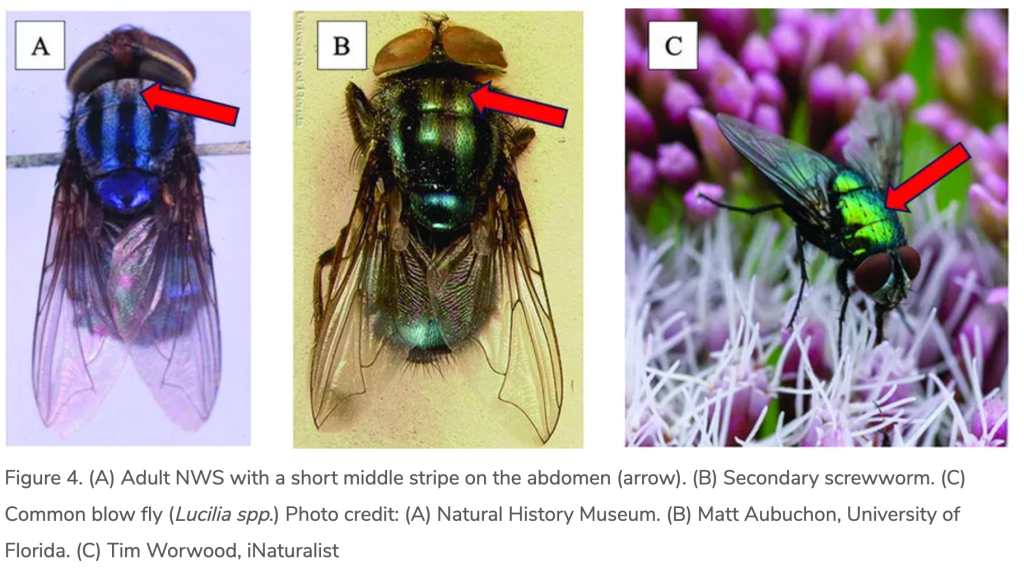
Due to the nature of their diet they are also prone to carrying diseases that can be harmful to humans, so as necessary as they are for our ecosystems, they aren’t great to have around your food, unless you’re fine with salmonella. Those are the necrophage blowflies – the sort that prefer a meal that is no longer breathing. The screwworm, however, is parasitic and prefers a heartbeat. The cycle is still the same – lay eggs (on living flesh), feast on said flesh, pupate (in the soil), and hatch – which means a very painful experience for the cattle who become infected as the larvae dig their sharp hooks into the skin and muscle to physically (and chemically) macerate the flesh.
Should we be concerned?
Apart from the mess our government made to ALL of our departments, this one is especially bad, not because it is spreading faster than other diseases (should we discuss measles, perhaps…?) or because it is affecting our beef industry (we could all eat far less of that, anyhow) – it is because it is affecting a system that is already in need of tighter restrictions and oversight, as well as improved animal welfare policies.
I’ve mentioned before the burdens of our factory farming in other posts, otherwise known as industrialized farming or concentrated animal feed lots or operations. Cattle on these ranches are generally less healthy, pumped full of antibiotics preemptively in order to prevent disease, and susceptible to wounds due to overcrowding, the machinery and fencing, the over production of milk, and the potential abuse. This is just an invitation for the screwworm to find a compatible home on the range. Furthering the perfect shit storm lies in just how common and clustered these ranches are in the southwestern U.S., dotting the lands throughout Texas and Oklahoma. Jumping from one cattle ranch to another wouldn’t be that difficult for a screwworm fly. Both states are also politically right leaning and advocate for no oversight on industry.
This story of the reemergence of the screwworm in the U.S. is just one of the many cautionary tales to co-emerge with the Trump administration. If you’re curious what poor management, climate change, and a deeply troubled cultural system looks like, just glance at what is happening in the U.S. We are writing the book in real time on what not to do. I want to believe this will wake a population that has been in slumber for several decades while the Reagan-era ideologies have slowly taken over our nation, but I find myself edging closer into the dark belief that we are merely catalyzing the end of human civilization, insofar as we know it. Sensationalized fear-mongering, however won’t change our current circumstance, so, instead, I will vote and urge others to vote. Don’t vote for parties, but vote for people with real ideas to make our lives and our world better. Tell your representatives that you want oversight of your food systems and stay informed. AND GO TOUCH GRASS!
Latest update, as of 11 June 2026: 7 cases (5 cattle, 1 goat, 1 dog)(https://www.aphis.usda.gov/animals/animal-health/livestock-and-poultry-disease/current-status/us-confirmed-cases-new-world)
- https://www.nal.usda.gov/exhibits/speccoll/exhibits/show/stop-screwworms–selections-fr/1958-1969 ↩︎
- https://www.congress.gov/crs-product/IN12558 ↩︎
- A lot of the data I collected for this section came from the following resources: https://content.ces.ncsu.edu/blow-fly-biology-management and https://agrilifeextension.tamu.edu/new-world-screwworm-fact-sheet/ ↩︎
- https://extension.psu.edu/understanding-the-new-world-screwworm-biology-identification-and-prevention ↩︎
Discover more from One Health Stories
Subscribe to get the latest posts sent to your email.
 One Health Stories
Well put
LikeLiked by 1 person
Thanks for this story. To think we were taking a responsive, One Health approach for decades that was proving successful, despite the challenges of international cooperation. Plus, it was economically responsible, supporting a sizable American industry. But the short-sighted DOGE supporters killed it, and destroyed years of carefully crafted infrastructure. The stories and images of mammals attached by these larvae are really disturbing. That’s what DOGE should have been reviewing instead of some pathetic bottom line cost. Rant over.
LikeLiked by 1 person
The images are so heartbreaking. I considered adding one to this piece, but decided not to due to how graphic it can be for some people. I think I saw it referred to as a flesh eating parasite, which is how I think we should all refer to it so that people understand what it is doing to the animals.
LikeLike