
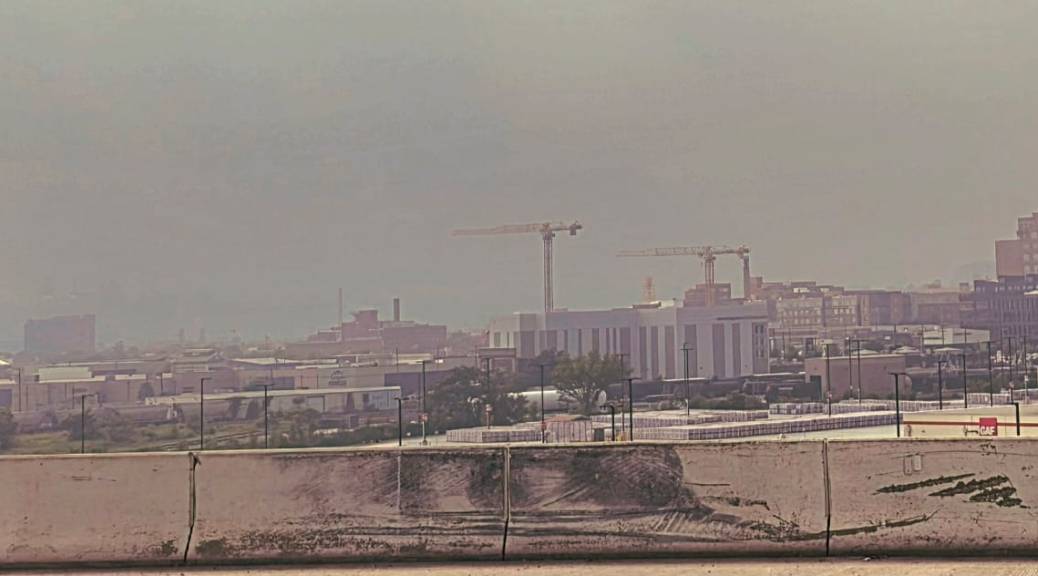
And I wasn’t even near it!
The air quality where I live has been generally poor, as of late. Not from one wildfire, but from two, plus a Haboob from the Middle East that blew sand halfway around the world to settle on the East Coast of the U.S.. It was the fire in New Jersey, however, that left a film in my mouth and throat and a grimy feel on my skin this past Saturday.
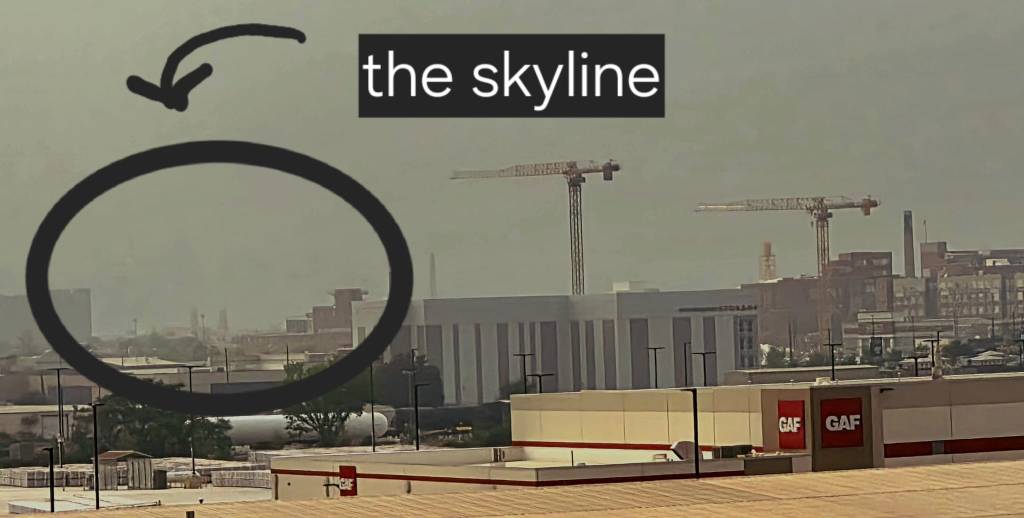
About 150 miles away the fire had been burning for about 3 days and was about 60% contained when we drove north of Baltimore for the day. As we passed the city, which is normally visible from each of the passing highways, all you could see was a dingy, brown haze that covered the skyline like a heavy cloak, smothering the buildings. The weather app on my phone issued a code ORANGE, as AQI (Air Quality Index) numbers exceeded the healthy levels.
My phone camera does a spectacular job of trying to make everything look beautiful and magical, so the images are far from how it actually looked, although I did my best to adjust the settings and capture what I saw.
Wildfires are becoming quite the health burden for life in North America, especially in California and Canada (Canada even has something called underground fires where the roots of trees continue burning long after the flames above ground disappear, which is another story). With these fires comes a host of complications from loss of forests, death and relocation of wildlife, poor air quality which can worsen cases of asthma and lung cancers (especially amongst firefighters), to increased zoonotic disease prevalence.
A 2021 paper by Albery et. al. point out that there has been very little research into the epidemiology of disease in wild animals in relation to wildfires, and noted that there are several factors contributing to this potential phenomenon. As humans continue to build out, further into wild spaces, we not only encounter more wildlife, but we also reduce the habitable areas for wildlife to build homes and forage or hunt for food. When we worsen the problem through human-caused or human-induced wildfires, we also increase the likelihood of disease transmission. Studies indicate that wild animals are more likely to become infected with parasites after wildfire events and we are co-mingling with them at greater rates.
Furthermore, wildfires don’t just cause stress to humans. They also stress the environments and the wildlife. This stress can also give rise to the same effects in animals as it does to humans by altering immune responses. Stressed humans get sick more frequently than non-stressed humans. The same is true for animals. These connections between wildfires, the climate, and disease call for a One Health action. It isn’t just a loss of raw materials, or green spaces for humans to enjoy. The devastation runs deep and affects us all, like falling dominos.
Discover more from One Health Stories
Subscribe to get the latest posts sent to your email.
 One Health Stories
I was waiting for where it would say, “Now here’s what you can do to help.” Is there no hope? Will they just keep getting worse?
LikeLiked by 1 person
I know the feeling! Most of the time, when I think of my little piece of making it better, I feel overwhelmed and pessimistic. I think it is possible to help, but it will involve big policy changes and re-thinking how we protect our forests. I’m a big fan of learning forestry services and controlled burning from indigenous people – methods that will be lost if we don’t preserve them.
LikeLike