
I am not a vegetarian or a vegan or pescatarian or anything. I hate labels. They confine us into a box and if you stray a little, then people love to comment on it. My eating style varies and I have good days/bad days and good weeks/bad weeks. In the winter I really struggle, succumbing to the scourge of seasonal affective doom and gloom – plus, I think we are all just hairless bears, refusing to hibernate as we ought to do. My point is, I don’t ascribe to any diets or self-proclamations that would limit my options.
That said, we do tend to eat little to no meat throughout the week and have experimented with several dishes that use vegetables to replace the meat. For those of you who are athletes or passionate meat eaters, you might be turning your nose up at the thought of a diet so “low in protein”. So, let’s explore that concept and see if it holds.
Breakfast (my classic weekday go-to)
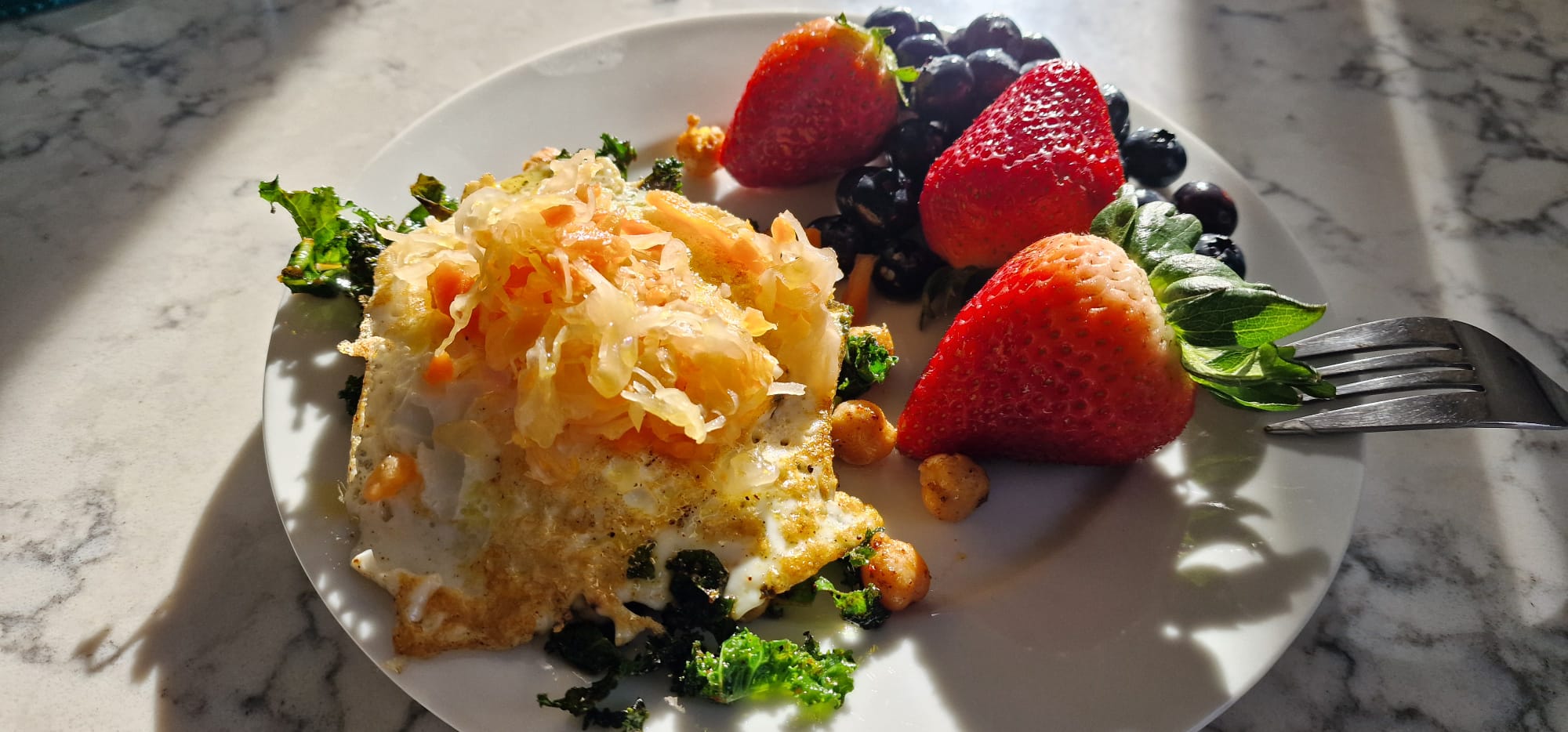
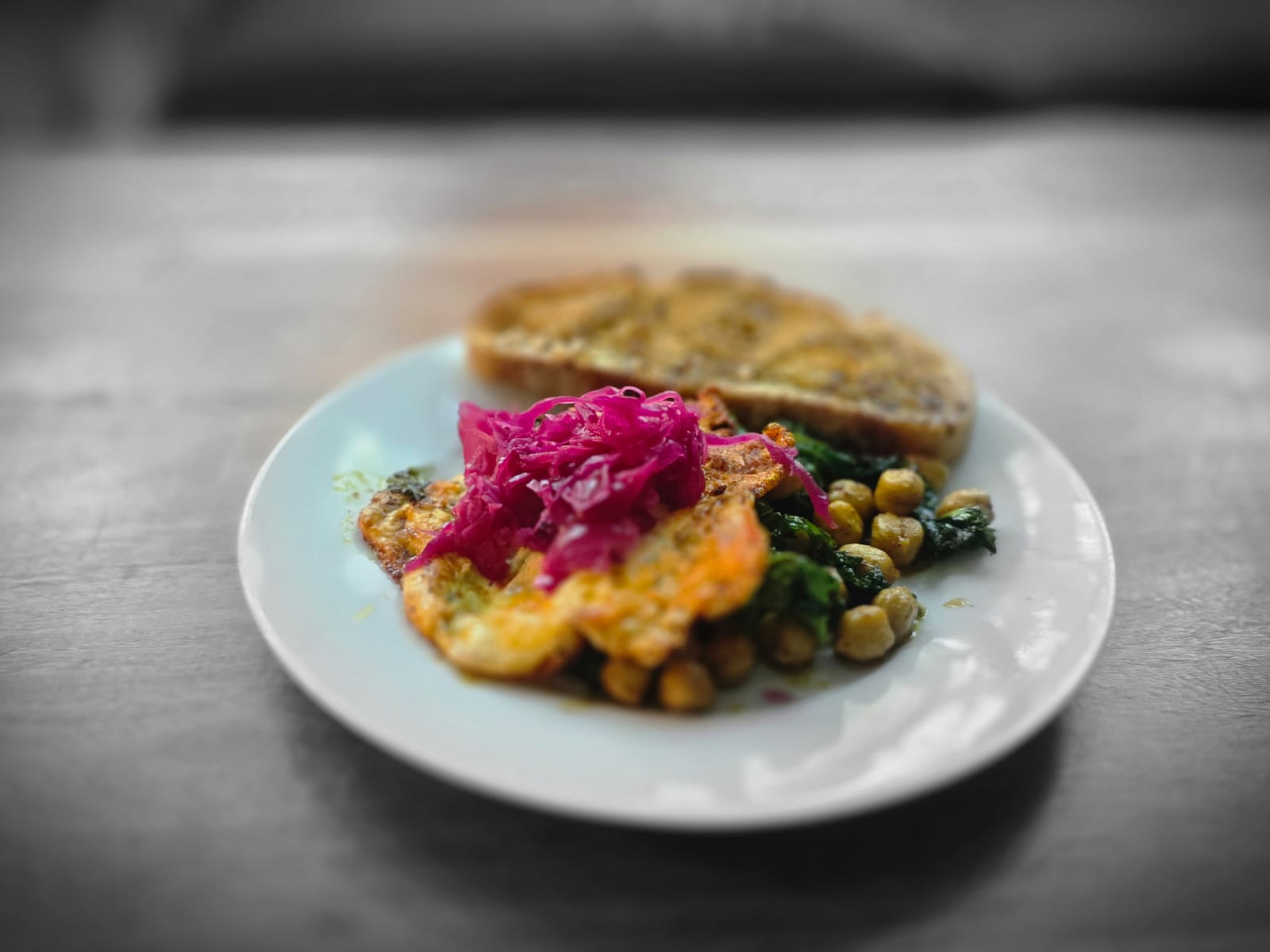
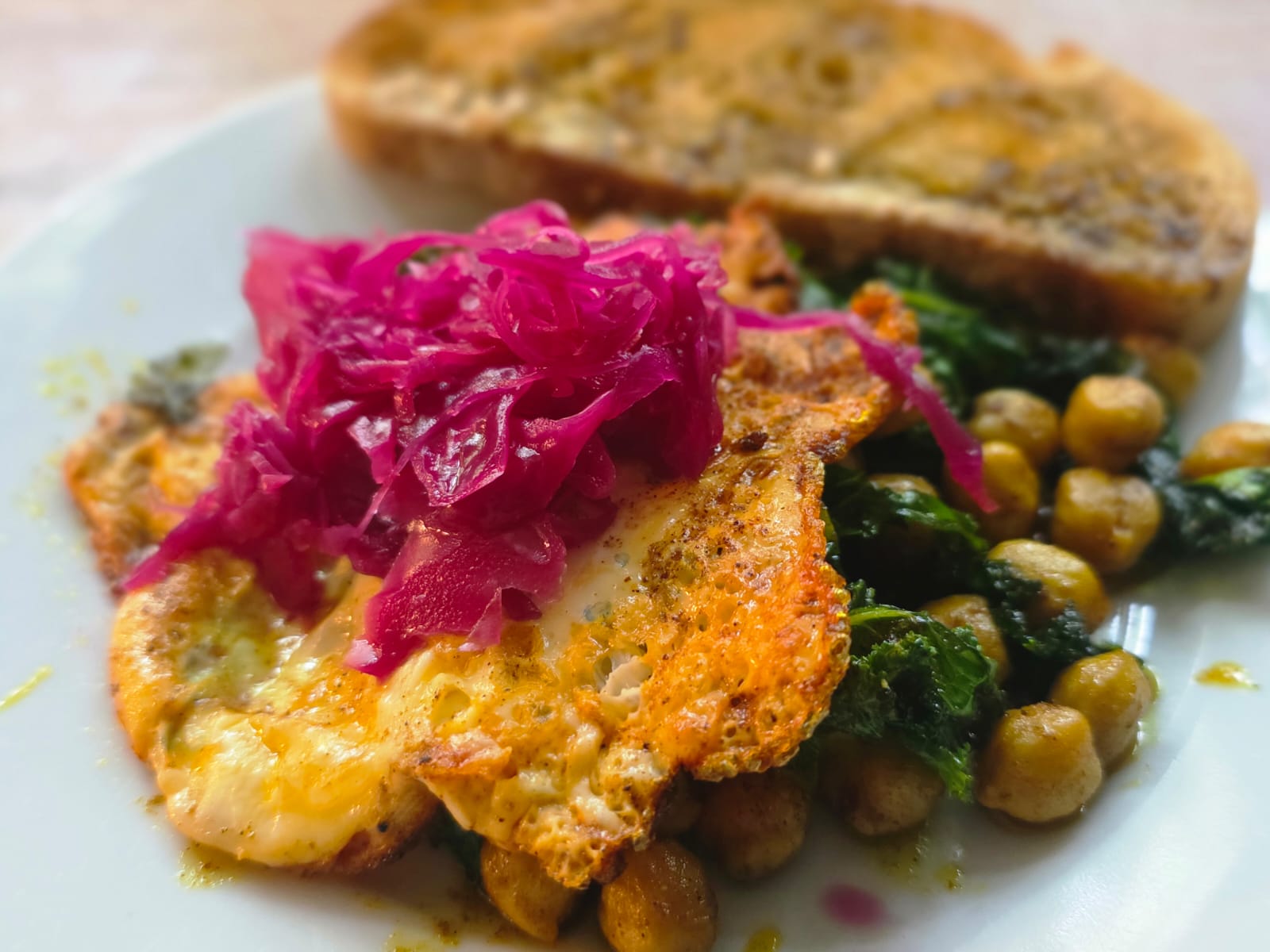
Let’s start with breakfast. One of my favourite breakfasts is the following:
Sautéed chickpeas (1/2 c) and kale (about a cup)
Seasoned with salt, pepper, turmeric, cumin, and smoked paprika
1 egg (however you like, I generally do over-easy)
Layer the egg on top of the veggies then top with fermented kraut (I prefer curtido or the garlic red cabbage I find at Wegmans).
Sometimes I add a slice of toasted sourdough bread, drizzled with olive oil
What is the protein content?
| Chickpeas (a.k.a. garbanzo beans) | 1/2 c yields just over 7g |
| Kale | 1 c yields about 2.2g |
| Egg | 1 yields about 6g |
| Fermented kraut | n/a (either 0g or negligible) |
| Sourdough toast | 1 medium slice yields about 8g |
| Total | 23.2g |
Modifications for this breakfast might be:
Replace the eggs with crumbled tofu (10g in 1/2c or 124g)
Add cheese (about 7g in 2 oz of shredded Sargento cheddar)
How Much Do You Need?
Given my weight (in kg) and age, this is roughly half of what I need for the day, and it was just breakfast!
Adult: 0.8g x (body weight in kg)
Ages 40-50: (1.0g to 1.2g) x (body weight in kg)
Athletes: (1.1g to 1.7g) x (body weight in kg)*
*Regular exercise is 1.1g to 1.5g and body builders/cyclists range from 1.2g to 1.7g
There are a couple of things that I’d like to point out with this.
First, everyone has different needs. If you’re body building, if you’re older, if you’re extremely active, or if you are trying to lose weight, your protein needs will vary. But…they don’t vary as much as you might think. You are still, very likely, consuming more than what is not only required, but also what is bioavailable.
Bioavailability is the availability of individual nutrients found in a food that your body is capable of absorbing and then using for various processes. In other words, if there are 50mg of vitamin B12 in a food you’ve just eaten, your body might only absorb and use 30mg – so only 30mg were bioavailable. Because we are all unique, that number is also going to be different. Certain diseases or conditions might increase or decrease absorption of some molecules; your individual metabolism is a major factor as well; and even how well we digest the foods, breaking them down into the individual components that nourish us, plays a role.
Side Quest: Unfortunately, one of the few substances we consume that doesn’t easily get flushed out into the toilet is sugar. Our bodies are spectacular at storing the excess as fat through a process called lipogenesis (fat does not make fat, sugar leads to fat). I am not suggesting we stop consuming sugars, as these are required to make energy (or ATP, adenosine triphosphate); but, like protein, we are already consuming enough sugars than what is required – most likely. You either need to burn the sugars up to use as energy or your body will decide what to do with it for you (and as with most things, it is more complicated, and there are other ways the body converts then stores excess sugar, and in higher doses can even flush it out with urine, but most commonly it is used as energy or stored as fat).
Second, the health benefits of acquiring protein from plant products are tri-fold. You get the protein, you get the fiber and other important nutrients found in plants, and you lose the negative effects caused by consuming animal products (possible shortened telomeres, increased risk of certain cancers, and increased risk of cardiovascular complications). You could even add a fourth and fifth point when you consider the environment and animal welfare, reducing the demand for intensive feedlots and industrial farming.
Other Foods Rich in Protein
The internet is full of data, and I’m not saying anything new here; but, while I think calorie counting is a waste of time, keeping a journal as a means of visualising what you consume each day can help you better judge what your body needs.
I was going to do a mock lunch, dinner, and snacks to really solidify the point I am trying to make, but I’m already impressed with my protein consumption for breakfast that I think I’ll just leave it at that. But, in case you are curious, here are a few other foods, rich in protein, that I like (based on 1/4c – a bit imperfect compared to using gram per gram, I admit):
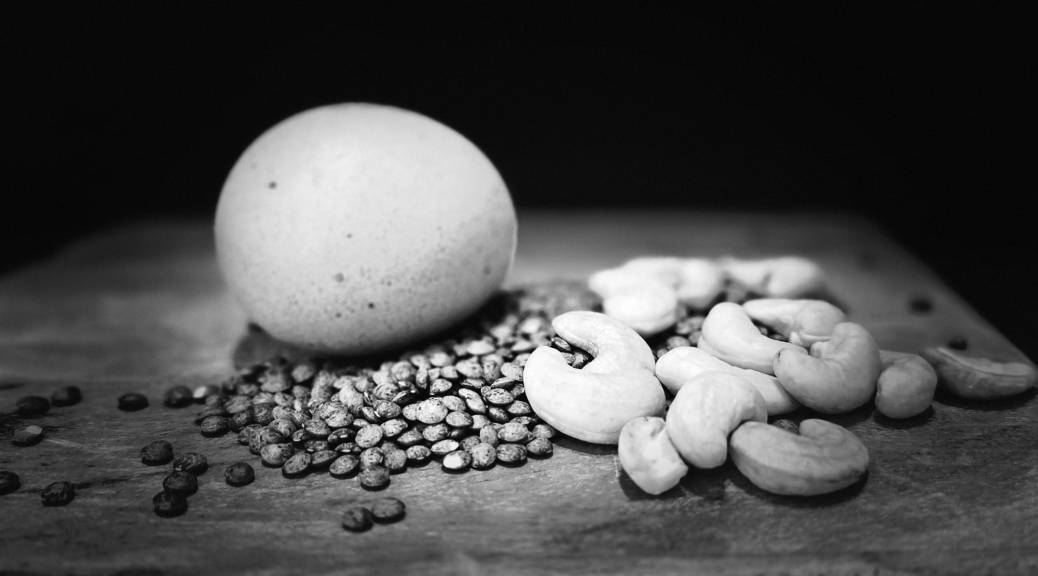
Nuts (about 7g for almonds and about 6g for pistachios)
Legumes (about 9.5g for peanuts and about 4.5g for lentils)
Grains (about 6g for farro and about 6.25g for barley)
Meat (about 9.5g for chicken and about 10g for salmon)
Dairy (about 4g for nonfat Greek yoghurt and about 7g for 28g of cheddar cheese)
Final Thoughts
This post came about because of what a trainer recently told a friend of mine. It isn’t as though I felt the need to outright dispute the trainer; however, those who specialize in fitness tend to push a lot of diet trends without a lot of nutritional knowledge. They love the pre-workout drinks, the protein shakes, and the high protein diets, but they are not nutritionists or registered dietitians. The truth is, nutritional science is a very difficult science to study and things are always changing as new information and better studies come to light. Nutrition is also holistic and just like you can’t isolate a workout to target one area of the body for weight loss purposes, you likewise can’t reduce a food down to a single molecule or a single molecule to the thing you need most. We need a variety of foods for a variety of purposes, and we are all unique.
Now, I have loads more to say about our farming practices, but that’s another topic…
Discover more from One Health Stories
Subscribe to get the latest posts sent to your email.
 One Health Stories