
Starting this week’s look into the environment and how it regenerates after trauma is a learning activity for me. I took some ecology and environmental studies coursework in my undergrad career, but as a biology major, my well of knowledge on the matter is fairly shallow and might hold no more than a few little row boats of information and wisdom. The first term I discovered in my research was: ecological succession (Witynski, n.d.). Primary ecological succession explains how life takes shape when a new island or other land mass is created, perhaps, by lava flows and results in a rocky terrain, void of any soil or plant life. Eventually lichens and other plants requiring little or no soil begin to appear, leading to grasses, then shrubs, then small trees until, finally, larger hardwood trees take over. After an extreme event that destroys an environment, a secondary succession takes place. This is similar, however, does not go all the way back to the barren rocky terrain phase. As the soil has been established it can pick back up with grasses, shrubs, and smaller trees.
The process of reaching a climax community, or a stable community of plants within a given ecosystem, is an incredible act of defiance and resilience from nature. Although it is an impressive accomplishment, it can take hundreds of years to reach this pinnacle, while the destruction may have taken mere minutes. Unfortunately, in a world where human induced climate changes are bringing catastrophic events to our natural habitats in rapid succession, is regenerating life possible without human mediation?
My blog is called One Health Stories, so maybe we should look at a story involving ecosystem recovery.
The Eruption of Mount St. Helens
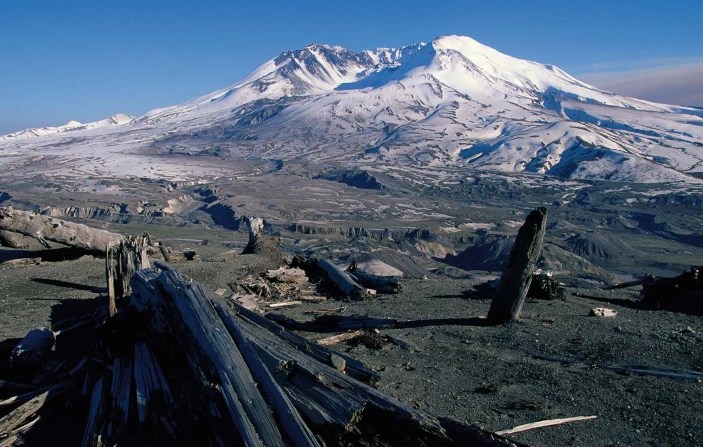
It was May 18, 1980 the day Mount St. Helens erupted. A series of smaller earthquakes in March had primed the dormant volcano for the catastrophic event that would later be triggered by a larger, 5.1 magnitude earthquake that spring (for the full story, see the U.S. Geological Survey site, link below). The lateral blast destroyed roughly 600 square kilometers, killing everything in its path. (Image credit below: Paul A. Souders/Getty, https://www.nature.com/articles/s43017-020-0059-5). Mud and ash slides, smoke, lava, explosions all contributed to the devastation. Lives, homes, roads, rails, and vegetation all perished.
Depending on how one measures tragedy or catastrophe, some might consider its more “remote” location lucky, as it spared more human lives and homes than it would have, had it been closer to a larger city, such as Portland, Oregon. I’m not sure there is a fair or just way to measure tragedy, however. Lucky or unlucky, Mount St. Helens is nestled in the Gifford Pinchot National Forest in the southwestern part of Washington State. This forest is brimming with vegetative biodiversity, much of it from a variety of conifer trees (about 84%) (Forest Service, n.d.). Two such trees that exist so beautifully together are the Douglas Fir and the Western Hemlock (Denniston, 2015). The Douglas Fir grows directly on soil, prefers sun, and can reach incredible heights. The Western Hemlock, another large evergreen, tolerates shade and sprouts on organic matter – even on old tree stumps! Together they, and other trees, shrubs, and perennials, create the emerald, dense forest of the Pacific Northwest. Considering these forests in the Pacific Northwest are anywhere from 350 to 1000 years old (Department of Bioregion, n.d.), the devastation of losing these ecosystems is not only tragic, but concerning. Even with human interference, it would not be possible to reestablish these old growth forests without the help of time.
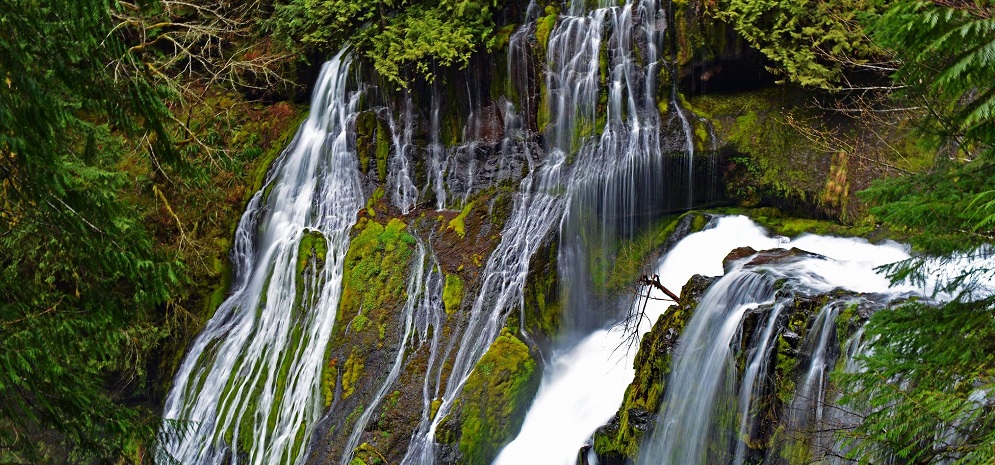
Did you know that the Gifford Pinchot National Forest is #4 in the U.S. for carbon capturing?
Image: USDA Forestry Service. Gifford Pinchot National Forest.
Rebuilding a Forest
So what did the State of Washington do after the 1980 eruption of Mount St. Helens? Even that story is a bit complicated. When reestablishing forests, ecologists might use a practice called silviculture (Forestry Service, n.d.). This is a practice whereby the planning operations consider what the purpose of the forest and land serves: wilderness, logging, recreation, etc. The land around Mount St. Helens had been owned by two separate entities. The logging industry and the Federal Government. The Forestry Services designated some land to go towards education, recreation, and research with the rest earmarked for rewilding (Sowards, A.M., 2024) while the logging industry aimed to restart their business enterprises. By 1982 Congress had created the National Volcanic Monument and efforts to repair the land really began.
Three separate processes were documented over the years. First, the logging industry cleared away all of the fallen trees from their land and planted about 18 million seeds of fast growing, production trees on about 45,000 acres. Second, the Forestry Services also planted seedlings on about 14,000 acres and opted out of the intensive salvage logging. The remaining 110,000 acres went to nature (overseen by the National Volcanic Monument), and although it took longer, seeds eventually made it to the area and began sprouting. In areas with less or no salvage logging greater biodiversity was observed. However, despite there being little biodiversity in the forests planted by the logging industry, their trees have also grown large and plentiful (70 feet by 2009, although the exact location was not specified – likely the lower elevations) (Sowards, A.M., 2024).
I’m not sure what the correct answer is here – a forest lacking in biodiversity, but a forest nonetheless, or a more authentic and healthy forest that takes much longer to develop. Most ecologists and environmental stewards might argue it is best to prevent the loss of these valuable ecosystems to begin with, but most experts believe we have passed the point of no return. The scenario I always find my mind wandering back to is one where humans suddenly vanished from the Earth – which forest would survive? Would, left to its own devices, the timber forest give way to more biodiversity without the farming from humans? Would there be more animals in the forest maintained by the Forestry Service? Or, is a denser forest, thick with fallen trees a tinder box for future fires? A topic that is particularly dear to me is that of our indigenous peoples. We, as a Western society, have attempted to erase the practices of the very people who have learned to care for the lands that we have chosen to exploit. When the panel of problem solvers is comprised of the same people who caused the destruction (even if indirectly), do we REALLY have all of the potential solutions?
Our Own Rebuilding
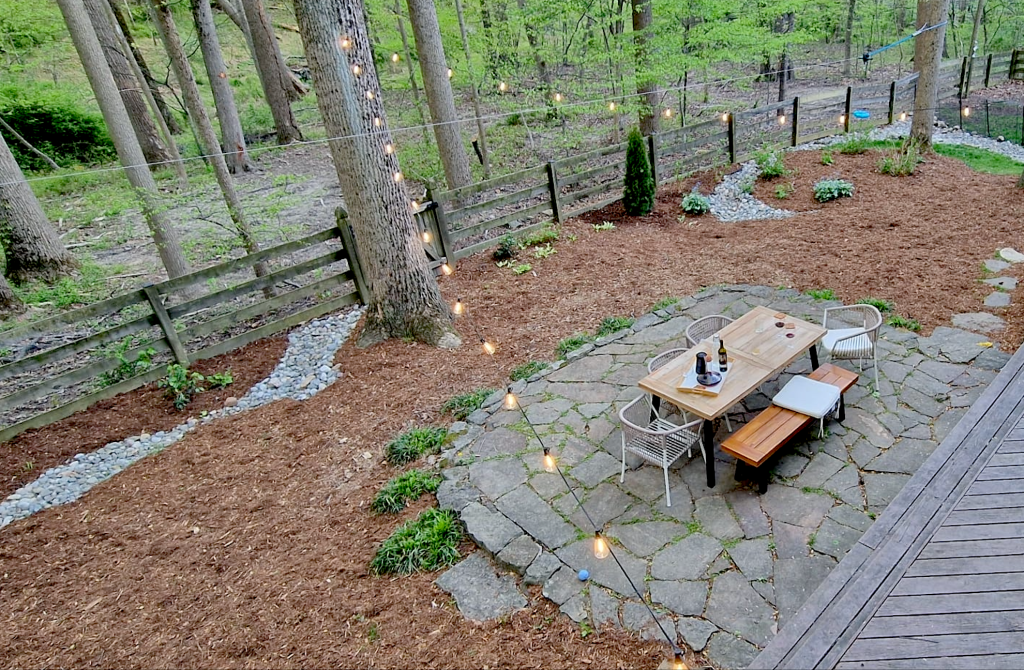
Perhaps it isn’t regenerating life and love, but rather regenerating life with love. When we bought our home after returning to the U.S. after seven years overseas we put some work into the backyard, all in an effort to make it a space prime for entertaining guests and relaxing. Every attempt was one failure after another. That is, until we learned to love and appreciate the space for what it is. It is a forested space that doesn’t prefer grass or showy perennials that love the sun. While we are still learning about the shade-loving native plants in our area, it has become very apparent that if we give our backyard the help it requires, it will do the hard work on its own.
References:
https://news.uchicago.edu/explainer/what-is-ecological-succession
https://www.usgs.gov/volcanoes/mount-st.-helens/science/1980-cataclysmic-eruption
https://www.fs.usda.gov/detailfull/giffordpinchot/landmanagement/resourcemanagement/?cid=fseprd1017891#:~:text=Mountain%20hemlock%2C%20Engelmann%20spruce%2C%20and,sparsely%20scattered%20throughout%20the%20Forest.
https://cascadiabioregion.org/forests-of-cascadia
https://www.historylink.org/File/22950
https://nwconifers.blogspot.com/2015/04/focus-on-western-hemlock.html
Further readings about the ecology:
https://www.csp-inc.org/wp-content/uploads/2022/02/CSP-Pew-Gifford_Pinchot_National_Forest-Final-Report-20211118.pdf
For more images from the eruption of Mount St. Helens:
https://www.nydailynews.com/2023/05/17/the-1980-eruption-of-mount-st-helens/
Discover more from One Health Stories
Subscribe to get the latest posts sent to your email.
 One Health Stories
One thought on “Regenerating Life and Love: The Environment”