
I thought I knew – but it seems I’ve opened up a can of worms that is taking way more effort to digest and understand. I thought “hey, let’s help spread the word about the importance of public broadcasting!” Now I need to figure out how we communicate across the nation. Either way, let’s also see if we can figure out what this administration just cut funding for, shall we?
So, let’s break this down bit by bit – as I am understanding it all.
First, you need a message to go out. Maybe a weather alert such as tornado, blizzard, etc. (FEMA), a missing person such as Amber (DOJ) or Silver (state) alert, closures for government or schools (varies), a change in some condition to an area like frozen ice roads in Alaska or an ongoing controlled burn (likely state-level), an emergency/disaster alert like mud slides, fires, and sink holes (also FEMA, usually), or maybe just some kind of news that needs transmitted to your citizens (even good news).
Second, you need that message to be broadcast as far and wide as is necessary (sometimes it’s a local, regional, national, or even international emergency). This means sending a message across multiple platforms, which include:
- AM/FM/VHF (FM)1 radio (analog/digital technology)
- TV with an antenna (analog/digital technology)
- Digital radio (digital technology)
- Cellular (digital technology)
- Cable TV (digital technology)
- Satellite TV/radio/phone (digital technology)
- Broadband internet/Fibre Optics (digital technology)
As you can see, most forms of communication are digital. What does that essentially mean for messaging? From everything I’ve been able to find, digital offers more channels and a clearer audio and image quality and the message won’t degrade over time and can be saved. Additionally, you can transmit text messaging as well as audio and image. The draw backs, however, are where the problems exist. The problems? Well…
First, their range is much shorter than analog signals (AM having the farthest range, although more degradation in quality, with FM coming in second, with the exception of the above mentioned VHF digital radio). As a result, the sender and receiver need to be relatively close to one another.

“Oh no, Sierra! I don’t think our walkie-talkie watches will work this far away!”
The same is true for cellular, having a maximum range for transmission purposes. Ever had your call drop or your music buffer on the road while you’re driving through the mountains? You lost signal from a cell tower. This can happen if there simply aren’t enough towers along the route causing a gap in service.
The second problem with digital is that it is expensive. Fibre and other broadband generally requires an entire infrastructure of cables to be laid and routed to your home or place of business. Satellite dishes, although less common where I live and rapidly being phased out of existence, also come with high installation costs, as well as monthly service fees (and prone to weather disruptions – not great if you’re using it to receive weather alerts).
Digital Deserts
Two interesting maps to compare are the map showing access to digital broadband services around the U.S. (top) and the map showing access to Public Broadcasting Services (what has been defunded – bottom).
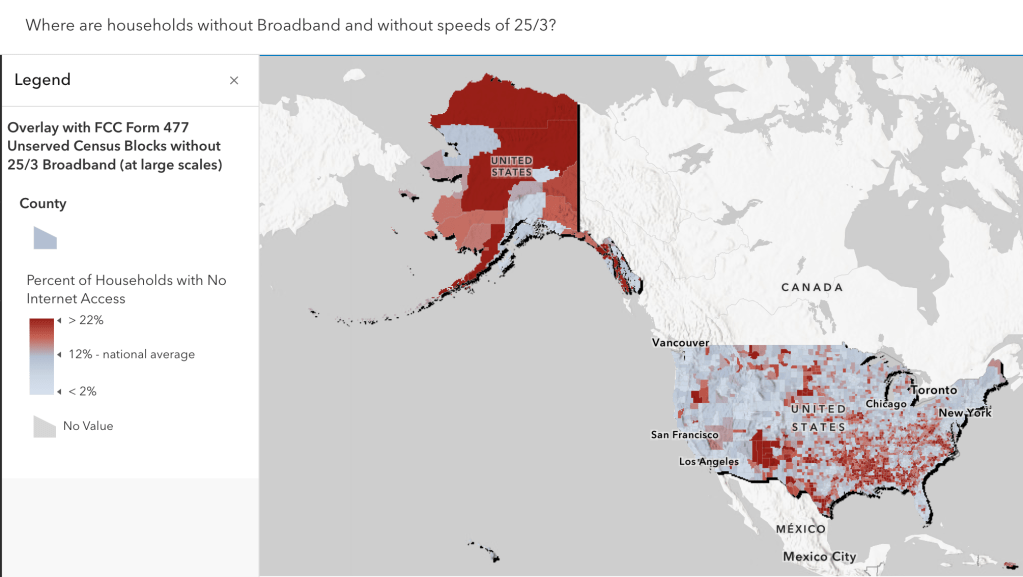

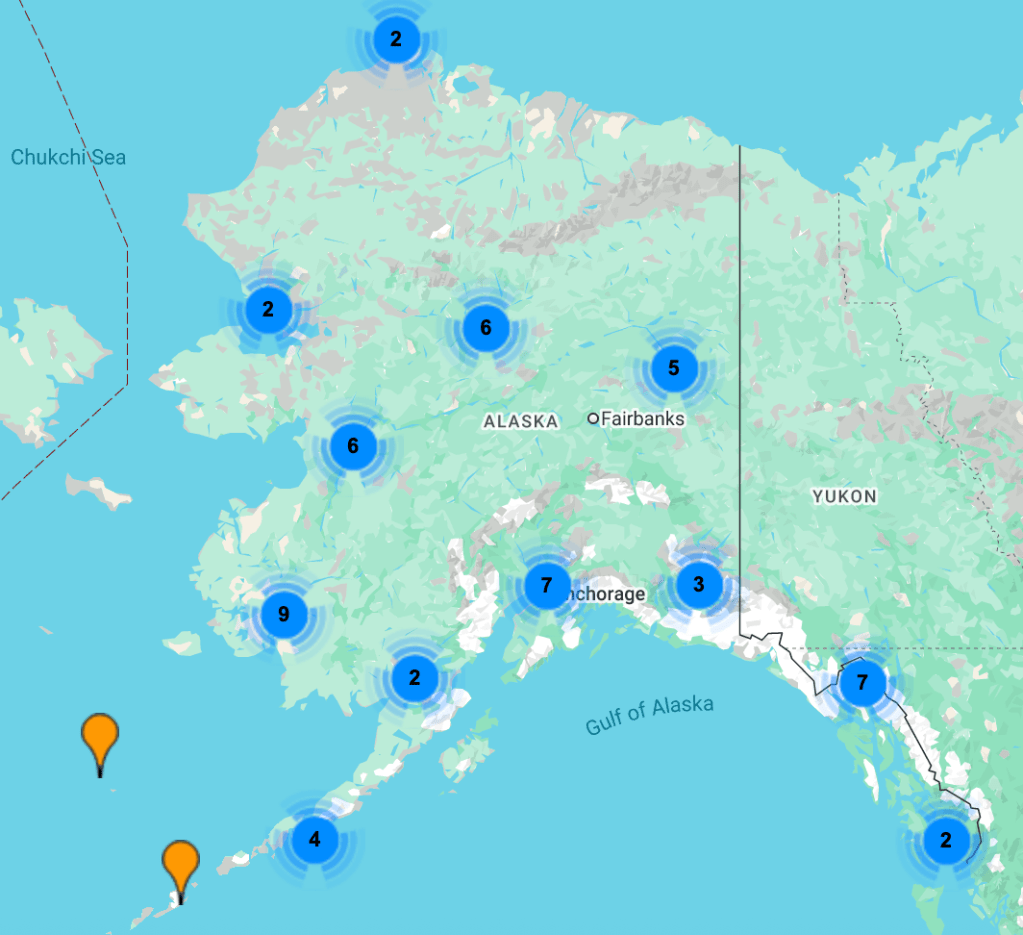

If you click on the individual stations for each area that correlated to a digital desert (those dark red spots), you would find that those stations are either analog or both analog and digital. To play around with the maps, yourselves, here are the links:
https://www.maps.com/internet-accessibility-map-shows-digital-divide-underserved-broadband-areas/
https://cpb.org/cpb-station-finder?sort=asc&order=State
Many of the places along these digital deserts are also in areas prone to extreme weather events and, although it is unclear where the funding for FEMA still stands (FEMA is who receives the grant money to operate the Emergency Alert System for weather and disaster-related messaging), the transmission of those messages may now rely heavily on private companies. But who knows. Some, thankfully, are part of NPR, who may have the resources to fundraise and make up the lost income.
The Corporation for Public Broadcasting
The easiest way to understand what CPB (Corporation for Public Broadcasting) is, is as follows: CPB is a bit like a bank for the infrastructure of public broadcasting (TV, radio, and mobile programming). It does not own anything, it merely distributes the grant money it receives from the Federal government to support the operation of stations and programming to the public. Without that avenue of funding, those stations, production companies who create educational television, and other services paid for by CPB will now have to seek funding elsewhere. Many of the larger public and national TV and radio broadcasting companies – PBS and NPR, for instance – receive a very small amount of money from CPB, relying more heavily on donor funds. Tiny communities in Alaska, however, might rely entirely on CPB funding. If I am reading the law correctly, the amount for the fiscal year 2026 awarded to CPB was $535,000,000 and an additional $60,000,000 for updating the infrastructure. While this might seem like a lot to us peasants, this is nothing. It is but a mere drop in the billions – nay, trillions – spent by our government.
Not all funding to support these broadcasting services comes from the CPB, but for those that rely on grants from the government, this is going to be a substantial loss. The system was put into place as a redundancy. Redundancies are important in emergency situations, so it is easy to cancel them when things seem good or okay.

I decided to write this on behalf of the three entities who I believe will perhaps suffer the greatest from these cuts. Indigenous people, other marginalized people in areas with degraded or nonexistent infrastructure, and the environment/wildlife. When the people no longer have reliable and easy access to information concerning evacuations, shelter in place orders, or disaster preparations, then they may suffer greater fatalities and tragedy to their communities. To further the problem, stations that may have to close will result in job losses and for those still broadcasting in indigenous languages may suffer a cultural hit.
Television supported by public broadcasting was always rooted in education, culture, and programs designed to get people thinking about, talking about, and understanding the world and expanding beyond their own, individual cultures. For some reason that is now being interpreted as “too left” and “woke”. I have no idea what will happen to communities who rely on this funding or what the landscape might look like this fall when hurricane season and the icy seasons take off. I hope that the philanthropic members of our society capable of helping, financially, will do so. It is clear that as this new regime moves forward we will be a nation on our own. Left to fend for ourselves.
I’m not the most knowledgable on this subject. I basically learned all of this over the last 24 hours, and might have gotten some of it wrong. If I did, please chime in. Knowledge and understanding is the most important thing these days, and I’d hate to contribute to misinformation. I’ve linked all of the sites from which I gathered my data. If I did get this all right, then I hope you also learned something! It’s a bit dry, but an important topic.
Hope you all have a great weekend!
References
Communications in Alaskan Wilderness
Importance of Public Broadcasting
Digital Deserts Map
Digital v. Analog signals
FEMA’s IPAWS
What is digital radio?
CPB Station Finder
CPB Financial disclosures
How Public Broadcasting works
All things CPB (their home site), full of information
The Rescission Bill
- VHF – Very High Frequency (FM waves) – radio that uses digital technology does not require any cellular or internet plan, which for some reason is breaking my brain because I can’t imagine using FM radio waves to transmit a text message (a feature offered with some handheld digital VHF radios). According to the AI overview (take that for what it is worth) it offers longer ranges and clearer audio than analog. One final note on these radios is to remember they are direct, two way transmission. You have to be on the same frequency, and someone with knowledge of the alert would need to radio that info in to you, hoping your radio is on, within range of you, and you are listening. ↩︎
Discover more from One Health Stories
Subscribe to get the latest posts sent to your email.
 One Health Stories