

Plastic. It seems like every time I open up Reuters or BBC news app people are talking about plastic waste and the environmental impact. In our most recent history, it has been portrayed as something that is “bad”. Although, I don’t think that is a fair assessment for much of anything that ever has or ever will exist. Good versus bad is simply not a useful measure of things. Dichotomies tend to lack utility and often drive divisive conversations.
Plastic is a pretty generic term to describe a synthetic polymer that can be made into durable, long-lasting materials, as well as what we call “single use” plastics (i.e. grocery bags and water bottles) and the components to manufacture each type varies, depending on their use. They are used for “good”, such as to create protective products (cars parts and healthcare items), lightweight shipping vessels, or children’s playthings and can also be turned into items that are “bad”, such as the aforementioned grocery bags and water bottles, take-out containers, soda can holders, etc.
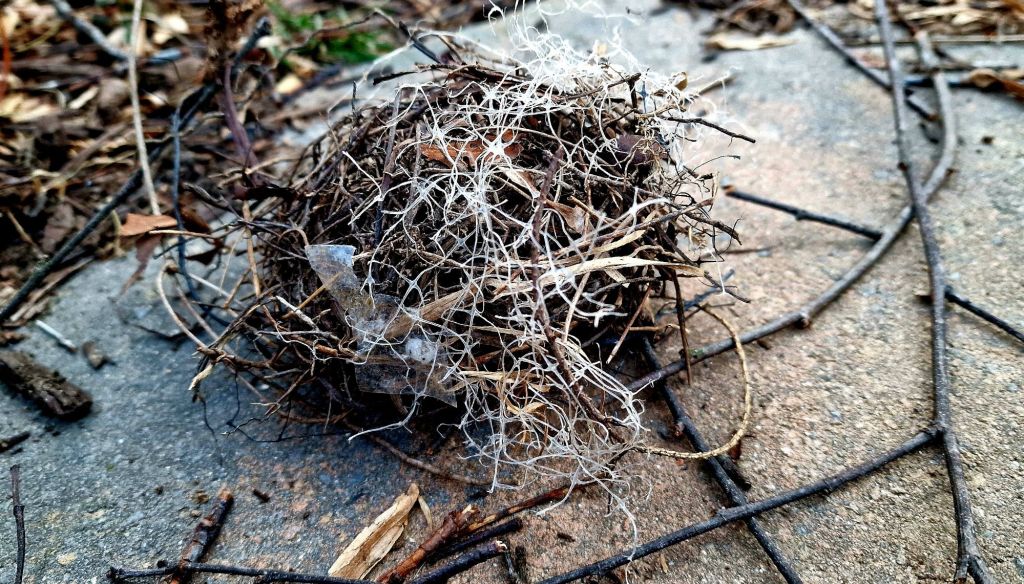
Although I’d love to spend an hour discussing plastic in some dogmatic or humanistic context, or dive deep into the various formulas we use, the purpose of this post spawned from a simple little bird nest. A nest I found in my front yard which, after inspecting it, had me questioning: is this nest, as it exists in its complete nest form, “yard waste” or is it “recyclable” or worse “landfill rubbish”? As more litter finds its way into forests, fields, and other natural spaces it too finds its way into the nests and homes of wildlife. My bird nest was a mix of grasses, twigs, and…plastic. Although the internet is filled with images of nests containing everything from straws to dolls and other human rubbish (sometimes even referred to as time capsules of the Anthropocene), my nest was adorned with a relatively modest amount of plastic. The worst part for me was that the plastic was something I recognized from my own yard. A mesh matrix that once held together a straw mat used to cover grass seed to prevent both erosion and seed loss from scavenging, allowing the grass to sprout and anchor itself to the ground. This mesh was mine.
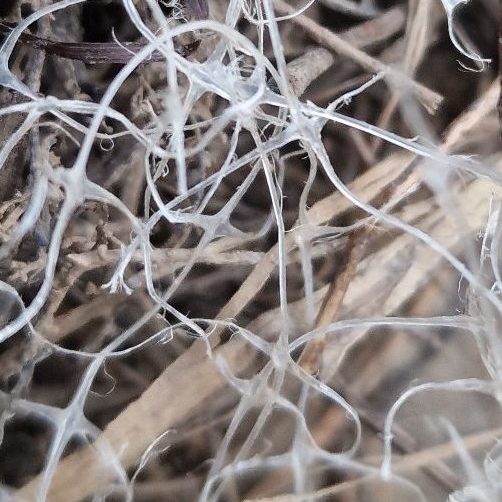
Intended to promote the growth of a resource-intense “crop” (a failed experiment), it was now in the environment (despite the touted “biodegradable” claim on the packaging) and rediscovered by my feathery neighbor. Was this bird upcycling? Was the bird participating in a circular economy? An attempt to “right my wrong”? Although my intentions to grow grass or use a straw mat with questionable biodegradability were not nefarious, my actions had consequences. Were those consequences “good” or “bad”? I think it was certainly less than ideal and there is a sadness in seeing nature innocently reduced to using human trash as building materials.
So, what is the One Health perspective here? For this story, there are many. Let’s start with the mesh, itself. The purpose is to facilitate the growth of grass. Most homes in the U.S. have grass lawns, which require a lot of water, are not great at preventing erosion or water runoff, and are often not native. Some areas of the world are considered grasslands and have their own ecological niche, but these grasslands are markedly different than those we find in the suburbs of America or on golf courses. We have since embraced most of the forested space in our backyard, replacing lawn with mulch, while allowing leaf litter to take over in the fall and winter, thereby providing homes for arthropods to overwinter. These critters are vital to a healthy environment as they are our pollinators, our detritivores, and soil stewards. They are also an important part of the diet for birds and some small mammals, helping to nourish other wildlife. Healthy outdoor environments also contribute to clean air and meditative spaces for improved human health. Another benefit to embracing the forest, free of a lawn? No more watering, which is intensely valuable to the future of all life that relies on fresh water supplies, as well as a cost efficient side effect.
Another One Health consideration is about the plastic itself. As plastics break down, they don’t disappear. They simply become smaller and smaller until they are “micro plastics”, a term many are familiar with today. We, along with all other life, ingest or absorb these microplastics into our bodies. There are still a lot of questions as to the long-term effects, but I can’t imagine they are beneficial to any of us. But what is it doing to the bird’s health as it exists in the nest they built? Other than it potentially and unintentionally ensnaring the birds who reside within the nest, a quick internet search suggests that poisoning and choking are also risk factors, especially when they are collecting their nesting materials.
The Anthropocene is marked by many rapid changes in our environment and the ways in which wildlife co-exist with us on this planet are evolving. I have never known a pristine Earth having been born near the end of the 20th Century. Human-made trash has always been a part of the parks and hiking trails I’ve explored, but the heaviness I felt at seeing MY plastic mesh in this nest weighed more than any other litter I’ve seen.
It was a physical testament to the impact that I had made.
My questions for the community:
Have you found plastic in the homes of your wild neighbors?
Was the trash from something you purchased and discarded?
Discover more from One Health Stories
Subscribe to get the latest posts sent to your email.
 One Health Stories